Thursday, December 12, 2013

Gangga Negara

Gangga Negara dipercayai merupakan kerajaan Melayu Hindu yang hilang dan ada disebut dalam Sejarah Melayu yang kini merangkumi Beruas, Dinding dan Manjung masa kini dalam negeri Perak, Malaysia dengan Raja Gangga Shah Johan sebagai salah seorang rajanya. Penyelidik percaya bahawa kerajaan ini berpusat di Beruas dan ia runtuh selepas serangan oleh Raja Rajendra Chola I dari Coromandel, India Selatan, antara 1025 dan 1026. Sebuah lagi sejarah Melayu, Hikayat Merong Mahawangsa yang dikenali sebagai Hikayat Kedah, Gangga Negara mungkin telah diasaskan oleh anak Merong Mahawangsa, Raja Ganjil Sarjuna dari Kedah, yang dikatakan sebagai keturunan Iskandar Agung or atau keluarga diraja Khmer tidak lewat dari abad ke-2.

Jabatan Muzium telah mengkaji kerajaan Gangga Negara dari pelbagai sudut termasuk tradisi lisan yang terdapat di negeri Perak. Muzium Beruas ditugaskan untuk membuat penyelidikan dari sudut arkeologi.

Kerajaan Gangga Negara meliputi Beruas dan Dinding/ Manjung . Terdapat artifak arca-arca Buddha abad ke- 5 dan ke-6 Masehi di Beruas menunjukkan kewujudan Kerajaan Gangga Negara ini. Kerajaan Gangga Negara berpusat di Beruas.

Pengasas Kerajaan Gangga Negara ialah Raja Ganjil Sarjuna dari Kedah. Pendapat lain mengatakan Kerajaan Gangga Negara dibuka oleh Raja Khmers dari Kemboja.

Kajian lain menyatakan Kerajaan Gangga Negara wujud tidak lewat dari abad ke-2 Masehi. Kerajaan Gangga Negara ini dipercayai terletak di daerah Dinding (Manjong) di kawasan Selatan Gunung Bubu (1657 meter ) arah Timur Bukit Segari di tepi Sungai Dendang. Pendapat ini juga menyebut kemungkinan pusat Kerajaan Gangga Negara berubah-ubah.

Dengan menggunakan jumpaan artifak-artifak purba dan pengaliran cabang Sungai Perak dipercayai pernah berpusat di Pengkalan ( Ipoh ), Lembah Kinta, Tanjung Rambutan, Bidor dan Sungai Siput telah dikatakan sebahagian dari jajahan Kerajaan Gangga Negara.

Kewujudan Kerajaan Gangga Negara dan kemudiannya Kerajaan Melayu Beruas tidak dapat dinafikan oleh penyelidik sejarah pada hari ini. Kedua-dua kerajaan tua yang dikatakan pernah bertapak di bumi Beruas bukanlah suatu dongengan ataupun mitos semata-mata. Ini berikutan beberapa peninggalan kesan sejarah mengenainya yang masih wujud di beberapa kawasan negeri Perak amnya dan Beruas khususnya.

Semua artifak dan gambar berkaitan dengan Beruas dipamerkan di Muzium Beruas.

Mana mana Kerajaan yang mengusai Semenanjung Tanah Melayu akan mengusai laluan perdagangan. itu sebab Siam,Khemer,Funan cuba mengusai Semenanjung Tanah Melayu.

Kerajaan-kerajaan silam Nusantara

1. Kerajaan Kandis* Lubuk Jambi Riau Sebelum Masehi
2. Kerajaan Melayu Jambi - Jambi Abad ke-2 M
3. Kerajaan Salakanegara Pandeglang - Banten 150 M
4. Kepaksian Skala Brak Kuno Gunung Pesagi - Lampung Abad ke-3 M
5. Kerajaan Kutai Muara Kaman - Kaimantan Timur Abad ke-4 M
6. Kerajaan Tarumanegara -Banten Abad ke-4 M
7. Kerajaan Koto Alang LubukJambi Abad ke-4 M
8. Kerajaan Barus Barus -Sumatra Utara Abad ke-6 M
9. Kerajaan Kalingga Jepara - Jawa Tengah Abad ke-6 M
10. Kerajaan Kanjuruhan Malang - Jawa Timur Abad ke-6 M
11. Kerajaan Sunda Banten-Jawa Barat 669 M
12. Kerajaan Sriwijaya Palembang - Sumatra Selatan Abad ke-7 M
13. Kerajaan Sabak Muara Btg. Hari - Jambi 730 M
14. Kerajaan Sunda Galuh Banten-Jawa Barat 735 M
15. Kerajaan Tulang Bawang - Lampung 771 M
16. Kerajaan Medang - Jawa Tengah 820 M
17. Kerajaan Perlak Peureulak - Aceh Timur 840 M
18. Kerajaan Bedahulu - Bali 882 M
19. Kerajaan Pajajaran Bogor - Jawa Barat 923 M
20. Kerajaan Kahuripan - Jawa Timur 1009 M
21. Kerajaan Janggala Sidoarjo - Jawa Timur 1042 M
22. Kerajaan Kadiri/Panjalu Kediri - Jawa Timur 1042 M
23. Kerajaan Tidung Tarakan - Kalimantan Timur 1076 M
24. Kerajaan Singasari - Jawa Timur 1222 M
25. Kesultanan Ternate - Ternate, Maluku 1257 M
26. Kesultanan Samudra Pasai - Aceh Utara 1267 M
27. Kerajaan Aru/Haru Pantai Timur, Sumatra Utara 1282 M
28. Kerajaan Majapahit Jawa Timur 1293 M
29. Kerajaan Indragiri Indragiri, Riau 1298 M
30. Kerajaan Panjalu Ciamis Gunung Sawal, Jawa Barat Abad ke-13 M
31. Kesultanan Kutai Kutai, Kalimantan Timur Abad ke-13 M
32. Kerajaan Dharmasraya Jambi 1341 M
33. Kerajaan Pagaruyung Batu Sangkar, Sumbar 1347 M
34. Kesultanan Aceh Banda Aceh 1360 M
35. Kesultanan Pajang Jawa Tengah 1365 M
36. Kesultanan Bone Bone, Sulawesi Selatan 1392 M
37. Kesultanan Buton Buton Abad ke-13 M
38. Kesultanan Malaka Malaka 1402 M
39. Kerajaan Tanjung Pura Kalimantan Barat 1425 M
40. Kesultanan Berau Berau 1432 M
41. Kerajaan Wajo Wajo, Sulawesi Selatan 1450 M
42. Kerajaan Tanah Hitu Ambon, Maluku 1470 M
43. Kesultanan Demak Demak, Jawa Tengah 1478 M
44. Kerajaan Inderapura Pesisir Selatan, Sumbar 1500-an M
45. Kesultanan Pasir/Sadurangas Pasir, Kalimantan Selatan 1516M
46. Kerajaan Blambangan Banyuwangi, Jawa Timur 1520-an M
47. Kesultanan Tidore Tidore, Maluku Utara 1521 M
48. Kerajaan Sumedang Larang Jawa Barat 1521 M
49. Kesultanan Bacan Bacan, Maluku 1521 M
50. Kesultanan Banten Banten 1524 M
51. Kesultanan Banjar Kalimantan Selatan 1526 M
52. Kesultanan Cirebon Jawa Barat 1527 M
53. Kesultan Sambas Sambas, Kalimantan Barat 1590-an M
54. Kesultanan Asahan Asahan 1630 M
55. Kesultanan Bima Bima 1640M
56. Kerajaan Adonara Adonara, Jawa Barat 1650 M
57. Kesultanan Gowa Goa, Makasar 1666 M
58. Kesultanan Deli Deli, Sumatra Utara 1669 M
59. Kesultanan Palembang Palembang 1675 M
60. Kerajaan Kota Waringin Kalimantan Tengah 1679 M
61. Kesultanan Serdang Serdang, Sumatra Utara 1723 M
62. Kesultanan Siak Sri Indrapura Siak, Riau 1723 M
63. Kasunanan Surakarta Solo, Jawa Tengah 1745 M
64. Kesltn. Ngayogyakarto Hadiningrat Yogyakarta 1755 M
65. Praja Mangkunegaran Jawa Tengah-Yogyakarta 1757 M
66. Kesultanan Pontianak Kalimantan Barat 1771 M
67. Kerajaan Pagatan Tanah Bumbu, Kalsel 1775 M
68. Kesultanan Pelalawan Pelalawan, Riau 1811 M
69. Kadipaten Pakualaman Yogyakarta 1813 M
70. Kesultanan Sambaliung Gunung Tabur 1810 M
71. Kesultanan Gunung Tabur Gunung Tabur 1820 M
72. Kesultanan Riau Lingga Lingga, Riau 1824 M
73. Kesultanan Trumon Sumatra Utara 1831 M
74. Kerajaan Amanatum NTT 1832 M
75. Kesultanan Langkat Sumatra Utara 1877 M

Monday, December 9, 2013

JOHOR: WARIS KERABAT SULTAN ALI IBNI SULTAN HUSSEIN

Akhir-akhir ini banyak orang mendakwa sebagai ahli kerabat diraja Melaka dan menuntut supaya ditabalkan sebagai Sultan Melaka. Melaka dari segi sejarah adalah pusat berkembangnya tamadun dan kebudayaan Melayu Islam dan sangat terkenal di dunia sebagai pusat perniagaan di sebelah timur pada abad ke 14 dan 15. Malah Melaka menjadi rebutan kepada bangsa asing dari dunia Barat kerana kekayaan dan kemewahannya. Kedudukan Melaka di tengah-tengah laluan laut kepada kapal-kapal perdagangan Timur-Barat menjadikannya berkembang begitu pesat. Faktor pentadbiran yang baik iaitu sistem pemerintahan beraja oleh orang Melayu dan agama Islam juga menjadi penyebab kemakmuran Melaka.

Melaka telah jatuh ketangan Portugis pada tahun 1511 tetapi kerajaan dan kedaulatan kesultanan Melayu tidak luput. Sultan Melayu Melaka telah memindahkan pusat pentadbiran ke Johor dan terus menerus menyerang Melaka yang diduduki Portugis kemudian Belanda dan akhirnya Inggeris.

Di era Belanda dan Inggeris pada abad ke 19, empayar kesultanan Melayu dipecah-pecah dan terbahagi kepada dua kesultanan. Perjanjian Inggeris-Belanda 1824 telah mewujudkan sultan Melayu di bawah kawalan Belanda berpusat di Riau dan sultan Melayu di bawah pengaruh Inggeris berpusat di Singapura. Sultan Abdul Rahman di Riau dan Sultan Hussein di Singapura adalah putera Sultan Mahmud yang memerintah kesultanan Melayu Johor yang wujud dari kesinambungan daripada kerajaan Melayu Melaka. Kedua-dua kuasa dan keturunan dua sultan ini akhirnya dimatikan atau dibekukan oleh Belanda dan Inggeris dengan tipu helah.

Mengikut ahli waris sultan Hussein, baginda telah dinasihatkan oleh Inggeris supaya tinggal dan memerintah kawasan Kesang yang dikhaskan kepada baginda dan waris-waris baginda turun temurun. Inggeris juga membenarkan Melaka untuk dijadikan kota pusat pemerintahan baginda disamping terus bersahabat dengan Inggeris. Sementara itu, keturunan Temenggung Ibrahim masih bekuasa di selatan tanah besar Johor, manakala keturunan bendahara pula berkuasa di Pahang.

Sehubungan itu, Sultan Hussein telah berpindah ke Melaka dan tinggal di Tengkera, kawasan tradisional kaum kerabat sultan Melayu Melaka dan mangkat di situ. Baginda telah diganti oleh putera baginda Tengku Ali yang telah menjadi sultan bagi daerah Kesang-Muar. Baginda tinggal di Umbai kerana terdapat makam nenda baginda dan akhirnya baginda juga mangkat dan dikebumikan di Umbai Melaka.

Nasib Sultan Ali adalah serupa seperti ayahanda baginda yang menjadi malang dan terus dalam kedukaan kerana muslihat dan tipu helah Inggeris. Melaka terus menjadi tanah jajahan Inggeris, tidak sebagaimana disangka oleh Sultan Hussein dan Sultan Ali yang yakin dengan janji manis Inggeris untuk membenarkan baginda menjadikan Melaka sebagai kota pemerintahan kerajaan baginda. Pada kenyataannya, sultan hanya dibenarkan tinggal di Melaka dan dikawal terus oleh Inggeris sehinggalah baginda mangkat.

Di era abad ke duapuluh ini pula, orang-orang Melayu menyaksikan bagaimana kerajaan Singapura mematikan kedaulatan waris dan kerabat Sultan Hussein di Singapura dengan mengambilalih Istana dan kawasan Kampung Gelam menjadi pusat kebudayaan Melayu yang hanya bertaraf sebagai pusat pelancongan.

Di waktu yang sama tidak kurang juga nasib yang serupa terhadap keturunan waris sultan Ali di Semenanjung. Mereka hilang kuasa setelah Tengku Alam gagal menobatkan diri sebagai sultan penganti ayahanda baginda Sultan Ali. Inggeris telah menjalankan tipuhelahnya dan selepas Perang Jementah 1879, Tengku Alam telah ditangkap dan dikuarentin di Singapura hinggalah baginda mangkat.

Kerajaan baginda di kawasan Muar-Kesang diperintah oleh Sultan Abu Bakar dan sehingga pada hari ini telah menjadi sebahagian negeri Johor dengan Tanah Takluk Jajajahannya. Walaupun begitu tuntutan hak terus menerus berlaku tetapi menjadi begitu komplikasi dan terabai kerana perkembangan politik semasa yang melanda Johor dan Tanah Melayu sehingga akhirnya terbentuk sebuah negara, Malaysia.

Mimpi buruk kepada ahli keluarga dan waris sultan Ali berterusan dalam marga mereka sendiri. Walaupun tiada lagi berniat derhaka mahupun permusuhan kecuali taat dan setia kepada sultan Johor dan kerajaan Malaysia, mereka sebenarnya terus melestarikan kedaulatan yang telah tiada ini dalam marga mereka. Sehingga kini terdapat beberapa entiti yang bergerak bersendirian dalam lingkungan yang terbatas. Mereka telah bergaul, bernikah dan menjadi rakyat biasa. Hanya satu keluarga yang menonjol iaitu keluarga Engku Saidin bin Engku Mahmud yang masih kuat dan sampai ke kerabat di raja sultan Pahang. Manakala disebelah isterinya Tengku Raimie sampai kepada Sultan Ali. Hanya keluarga ini yang masih ada organisasi tidak rasmi yang ada Bendaharanya, Temenggong, Laksamana, Panglima yang dilantik mengikut keturunan.

Kini, struktur organisasi tradisional ini diwarisi dan diaktifkan oleh anakanda beliau Engku Khairul Azuan bin Engku Saidin. Keadaannya masih terbatas dalam marga mereka sendiri tetapi ada kemajuan kerana kesahihan mereka dimaklumi oleh kerabat di raja Pahang dan Kerabat diraja Johor walaupun tidak secara rasmi. Ini adalah disebabkan hubungan sirahturahim kebiasaan yang berterusan. Darah keturunan dan persaudaraan masih bertaut. Struktur Organisasi walau hanya seperti bayangan pada Engku Khairul Azuan bin Engku Saidin ini, juga dimaklumi dan ada kerjasama dengan Persatuan Waris dan Keturunan Temenggong Muar (PEWARIS), Persatuan Waris dan Kerabat Sultan Hussein Singapura, Persatuan Waris dan Kerabat Bendahara Johor, dan Waris dan Kerabat diraja Pahang.

Terdapat juga keunikan pemegang jawatan atau jabatan iaitu seperti Bendahara, Temenggong dan Laksamana kepada Engku Khairul kerana mereka juga adalah dari darah keturunan raja atau saudara mara kerabat. Seperti Tun Bendahara iaitu bendahara kepada Engku Khairul berstatus atau pangkat bapa saudara pupu beliau dan darah keturunannya sampai kepada kerabat di raja Negeri Sembilan dan juga kerabaat diraja Pahang di samping Melaka dan Kesultanan Cerebon. Mereka yang dilantik, meskipun tidak bergantung kepada kelulusan tinggi akademik tetapi mesti mempunyai tabal atau alat kebesaran warisan keluarga. Dan kesahihan sekuturunan diraja atau kerabat walaupun mereka telah didiskriminasi dan menjadi orang biasa adalah dimaklumi dan diketahui.

Sumber (c) http://wariskesultananmelaka-yayasansulami.blogspot.com

Tuesday, November 26, 2013

Melayu, Malagasi & Madagascar:


Author: Benign

1 - I had the opportunity to read an old journal that is published by a British learned society in the field of geographical science named Royal Geographical Society , entitled Proceedings of the Royal Geographical Society Vol. VII for the 1862-63 session . On page 69, entry dated Feb 9 , 1863, there was a report in respect of the terrain and geographical conditions of the world 's fourth largest island , Madagascar Island.

2 - The language spoken by the population of Madagascar is Malagasy . A little about this language , Malagasy as Hawaiian and Rapanui speech belongs to the Austronesian language family in which one of the two largest fraction is Malayo-Polynesian . To facilitate understanding, this is one of the Malagasy language of expression that includes a large family in our native language , Malay language . It was not difficult for us to understand the price of an item is worth folo , roapolo , telopolo , efapolo or enimpolo. Ten , Twenty , Thirty , Forty and Sixty.


3 - According to the journal , and alphabetic writing system supposedly never been introduced to the people of Madagascar until the arrival of Christian missionaries to the island in the early 1850s. One of the missionaries , Rev. . Mr . Ellis , who left the island for several years , very surprised after his return to the island and found a general Madasgaskar was busy copying a message from the lip superiors to send one part to another island.

4 - Even more surprising missionaries are there a large number of Malagasy words this is a direct adaptation of the Malay language. It opens the door to some extent the answer to the question that bane of scholars at the time. While Madagascar is located close to the African continent , why it does not have anything to do with the continent. In terms of revenue and types of plants, what is in Madagascar is different from the countries of the continent. Even the average population of Madagascar do not know what the Zebra and Giraffe .Traditional houses on the coast of Madagascar.

5 - The houses are built by the people of Madagascar are not directly mimic the structure arkitektual available in African countries . Houses in Madagascar more equal houses from the Malay archipelago . Most of its residents were found to prefer to wear a selimpang called Lamba made ​​from plant ties . Unlike the usual African natives who prefer to wear animal skins.Merina tribe woman with white Lamba.


6 - The report goes on to state , though there is a huge difference between the people of Madagascar and the Malay Archipelago , they also have facial features that contrast with the typical shape of Africa nation.

7 - Even in terms of culture and civilization , the people of Madagascar are seen to have a far more civilized achievement advans and move ahead as compared to their counterparts from the African continent away may not have 300 miles . Evidence of the level of civilization , according to reports the Royal Geographic Society in 1862 , is based on language spread across the entire island , something that could not happen without the availability of civilization advans.

8 - According to the report, there has never been black people who know to create characters , but after reviewing the Malagasy language , the Royal Geographic Society officers discovered nearly 200 words a clear, comes from the Malay language. 

9 - Citing the report, very rarely are people from the African continent that knew how to count . Races ever discovered by explorer Dr.Livingston was only able to count to 10 only and almost nothing that can count up to one hundred units . But in Madagascar , indigenous tribes that lived on the island is able to calculate the unit up to a hundred thousand under the influence of the Malays who migrated to Madagascar . No wonder the word for ten thousand and one hundred thousand in the Malagasy language is clearly derived from the Malay word Sanskrit. 

10 - Researchers next Royal Geographic Society has issued an opinion that at one time may be a group of Malay sailors shipwrecked on the island of Madagascar as a result of the turbulent monsoon . As the number of them in the pretty much to ensure their safety in the face of the threat of the original tribes who settled on the island, they decided to settle down and build a settlement on the island. 

11 - After such time, the Malay sailors captured tribes - tribes remained even ruling caste . The browser has also taught the tribes - tribes with farming knowledge and use the types of crops grown in certain parts of the island ( to answer why the natural landscape in Madagascar earth different countries of Africa) . Through intermarriage , finally the Malay browser is integrated with the original tribes that inhabited Madagascar.
 12 - I subsequently made a little reading about the history of the island of Madagascar through Wikipedia. and of course there are sources that say that the Malays have long been in Madagascar during the first time it was discovered by the European sailors . Jared Diamond wrote in his book Guns, Gems & Steel : The Fate of Human Societies published in 2001, was quoted as follows :

    
These Austronesians, with Their Austronesian language and modified Austronesian culture , were already established on Madagascar by the time it was first visited by Europeans , in 1500. This strikes me as the single Most astonishing fact of human geography for the potentials world . It's as if Columbus , on reaching Cuba, found it limits Occupied by blue -eyed , Blond - haired Scandinavians speaking a language close to Swedish, even though the nearby North American continent was inhabited by Native Americans speaking A Merindian languages.


13 - Through a number of sources that I read again , descendants of the sailors is today known as the Merina tribe , tribes are considered noble and aristocratic quarter in Madagascar . These tribes still remains today as the government in Madagascar. Interesting?

Monday, May 23, 2011

History of Srivijaya

Srivijaya was a Malay thalassocracy centered on Palembang (Sumatra), existing from the 7th to the 13th C. The historical evidence is scanty, consisting of a number of inscriptions, a few stories of mostly Chinese visitors, archaeological evidence. It is believed that Madagascar was settled by Sumatrans before the arrival of Indian religions on Sumatra. Srivijaya expanded, annexing Melayu (Jambi) c. 680, taking control of the Malacca Straits. A Chinese visitor around that time describes Palembang as a center of Buddhist scholarship.

Srivijaya at its climax controlled Sumatra, West Java, the westerly and northern coast of Borneo and the Malay Peninsula. In the Malay Archipelago it had a rival in Sailendra, another thalassocracy centered on Central Java, and after the latter's fall in 852, in the Kingdom of Mataram, also concentrated on Central Java. When the Sailendra Dynasty was ousted from Java in 852, they moved to Palembang and took over the rule of Srivijaya.

By 1200 Srivijaya was still a major regional power, but the center had moved from Palembang to Jambi. In the course of the 13th century Srivijaya disintegrated. The Kingdom of Palembang continued to be identified with the name of Srivijaya; its territory was limited to southeastern Sumatra without Lampung (to Pajajaran). In the north it bordered on Jambi. In 1290 it was conquered by Singhasari.

Jambi, Palembang, Pajajaran and Malacca may be regarded successor states of Srivijaya, indirectly also Brunei and the Sultanates of North Sumatra such as Aceh.


Wednesday, December 8, 2010

THE CITY OF MELAKA


Is this a replica of the palace of Malacca meets the original architecture?


This time I will show you an article on the construction of the glory of Malacca. The bulk of this sketch has not been published by any party in our country because it can be said to be fresh from a primary source obtained from the Netherlands and Portugal. So you lucky to be looked at here. But this is only a small portion of the many sketches that successfully brought home by the researcher team of the University. Hopefully this article I thought we could open the box with a wider civilization of the Malay race in the past.


Sketches showing the city of Malacca at the time of Portuguese colonial rule. Sketches made to record the attack on the Fleet Aceh Darussalam during the siege to the city for about a year. In this sketch there appears a thrower of weapons used by the military Acheh.


Actually, when an Italian explorer named Ludovico Vertema visited Melaka between the years 1506 to 1510, the Portuguese often sent spies into the personal lives of Malacca to find information on the progress of trade, society and the state of Malacca. The important information carried by the Portuguese who came to Malacca in 1506 and 1508 was about the defense strategy of Malacca. Some of the sketches on the form and building cities, palaces and the position of the port city of Melaka successfully recorded. Among these sketches suggest a city wall and gates Melaka strong and built from local materials such as laterite stone. Construction materials is already widely available in Singapore. Both of Jorge Mello traveler who came in 1507, and Jorge De Aguilar came in 1508, has been sending information to a government historian of Joan De Barros Portugal.


From a sketch made, it proves the technology at the time of the Malays. Physical development and infrastructure, Singapore was a security feature robust and comparable to the cities in other Asian countries. In this case, the possibility of getting government Malacca Gujarati labor of people who are famous not only as traders but also as a craftsman builder of houses and buildings. It also reflects the existence of the spirit of close cooperation between the artisans Malay Muslims in Singapore and India in terms of urban and port development pentadbiranya according to Islamic law.


The information obtained from a sketch published in the Netherlands in 1508 also showed that the gateway to the city of Melaka is now actually not from the original Portuguese building materials. Based on a sketch found through research that was done, found the original construction of the Malacca Portuguese destroyed have been replaced and modified by the Portuguese architecture. The same architecture is seen in Goa, Macao and Ternate. This information is quite proud of the Malay Archipelago in particular and in general because of this sketch a proof of the civilization of Malacca at that time. Means that the sketch represents how the ability of the Malays exhibit the ability to race and pride of his country on par with other nations. In this case, the information recorded in the history of the Malay Hikayat Hang Tuah and able to record the achievement of Malay culture and civilization at the time.


Sketches of Portuguese also record the events that occurred between the wars with the Portuguese fleet of Malacca. From the sketch shown that the cannons from the ship to destroy the Portuguese strongholds of Malacca and the defense of the ships owned by a Muslim merchant. In the sketches were also seen dikejauhan buildings in the port city of Malacca and Singapore. It is clear from the sketch there is a banggunan a dome and minarets of the mosques of Malacca is likely or even castles.There are also many other buildings that line up the look of stone or concrete and more than two floors, this building was probably a palace of the sultan or a building in the complex populous port city of Melaka.

The above sketch shows the Portuguese fleet attack against the city of Malacca. Number of number of vessels in a sketch show not only the Portuguese soldiers involved in the attacks, but may also mercenaries.

If you all look exactly the sketch attack the Portuguese fleet, you will be able to see from a distance at the port of Malacca series of large buildings, multi-level and also vaulted and has a few towers. Could this be a palace or mosque Singapore real?


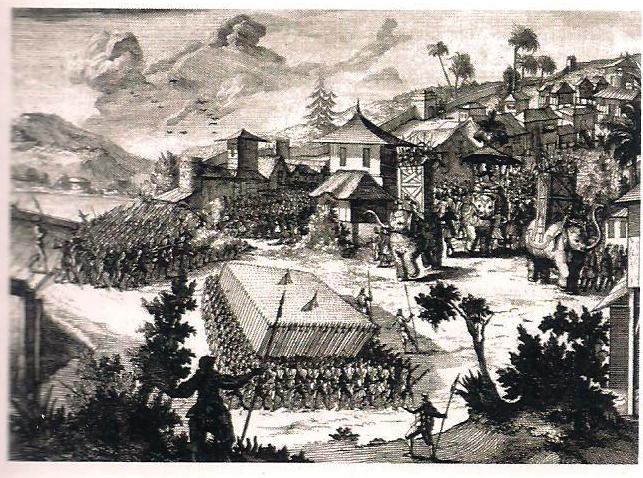
Melaka event of war have also recorded with sketches were made by the Portuguese.The sketch shows the strategy of the Portuguese attack on the city of Malacca and Singapore as well as how those strategies to defend their town ranks of warriors and the warriors show even a war elephant. In this context, a form of carriage device strapped to the elephants and the captain-commander issued to carry out attacks against the Portuguese troops who are ready to face the attacks of Malacca. These sketches also show how different attack strategies used by the Portuguese and the people of Malacca. The Portuguese seem to use tactics of attack, while the Malays are more defensive. Based on these sketches, we can see the weapons used by both sides.Portuguese term used lebing commonly used in Europe, while the Malays use a spear or spear is shorter. What is interesting is to look Melaka city wall has been built with local materials such as bricks and laterite. The wall design also shows the structure of the building which is equipped with reconnaissance places at certain angles. While the architecture in the city seems Malay houses are owned by the administrator and the merchant.

Sketch shows the military events of the Portuguese attack on the city of Malacca. This sketch is the first time we discovered by historians. So far most of the sketches that we find there is a picture painter. But the sketch is believed to be contemporaneous with the events of the actual sketches. Therefore we can assume that this is a picture of a sketch artist at a time when those who are.


There is another sketch secured by my professor and peprustakaan archives in Lisbon and the Netherlands. Visit of representatives of the Portuguese traders in 1509 Lopez De Sequeiraa to Melaka city traditionally celebrated the greatness of VIPs from outside the state have drawn. In this sketch he was honored to ride an elephant who became one of the Malay kingdom of Transportation official. In the march towards the palace of Malacca, the Portuguese delegation accompanied De Sequera. This sketch shows the architecture of the city walls and gates of the palace of the sultan of Malacca is made of building materials is strong. Based on these sketches, the wall of the building materials are of local white stone. While the Palace of the Sultan of Malacca is also made of the same materials. Therefore, the court found Melaka in Malacca is now not meet the original architecture of the palace is made almost entirely of bricks. The parade attracted a surprising number of people of Malacca to the Portuguese arrival.In the sketch tersenut also shows the guards and the warlords outside the gates of Malacca carry spears and bows are very large. They also wear more than par lutu and the other wrapped around the waist with a pattern. Do not change their clothes as clothes Roman times. Istana Melaka has sketched a balcony or berandah overlooking the port and the sultan was seen sitting on the Balcony while awaiting the arrival ofthe Portuguese envoy with the ministers and warlords. The castle was also stratified according to the word in Malay History.


Sketches showing the procession to the Istana Melaka Portuguese envoys witnessed by the people of Malacca.Interestingly the population melaka are surprised to see White Bengalis are also listed in Malay History. More attention is building the Palace of Sultan of Malacca.

But the all-reader, now has missed maybe a quarter of the questions about the greatness of the city of Melaka is often speculated in the records of foreign travelers and the. We can also look in more detail how to build it fast and Town of Malacca and the defense system of the sketches that I show. Hopefully it will benefit you to all members. Wallah hu knows best.

Source: http://lokalgenius.blogspot.com/

MALAY INFLUENCE IN THE COMMUNITY Bugis-Makassar

Salam, I came across an article that is interesting after following the link provided by Miss MO Kowloon from blog comments. I think this article makes it very attractive when posting here because it is a study that could open the minds of young Malays, especially in Malaysia which still do not know Who is the Malay race and the contribution of people who say this stagnant and lazy person. The following are articles taken from the Malay Porch Blog:

Indeed, the presence of nobility Bugis-Makassar Malay Archipelago is like the phenomenon of reverse flow of history. Long before they enter the heart of the power of the Malays, the Malays, who first role in local dynamics in the state of Bugis-Makassar.

Following the fall of Malacca to the Portuguese (1511), not a few relatives who went to court several points of the compass. Some groups traveled to the South. Kingdom of Gowa in the area they live in Salojo, coastal areas in the village Sanrobone Makassar.


Mukhlis PaEni search results, historian, social anthropologist from the University of Hasanuddin, shows that until 1615 the economic cycle, especially antarpulau trade through the port of Makassar, is controlled by Malays. New in 1621 the Bugis-Makassar took an important part in world trade and shipping in the archipelago.


"Since the arrival of the Malays in the Kingdom of Gowa, their role not only in trade and the spread of religion, but also in socio-cultural, even in the bureaucracy. In the Government's power structure Gowa, many Malays who plays an important role in the palace, "said Mukhlis, who also is Chief Historian Indonesia Society (MSI).


At the time of King Gowa X (1546-1565), for example, a descendant of mixed Malay-Bajau Makassar very reputable name I Mangambari Kare Mangaweang Harbour Master was appointed to the Government Gowa-2. Since that time, said Mukhlis, a hereditary position held by the port master of the Malays, to Syahbandar Incek Husa when the Government was defeated in the war against Gowa VOC in 1669.


Another important department is the court clerk, when the Incek Amin served at the time of Sultan Hasanuddin (1653-1669). The jury wrote in the castle is very famous through his poetry is very beautiful, Shair Mangkasar War, tells the last moment the Government of Gowa in 1669.


According to Mukhlis, the main contribution of the Malay Archipelago in the eastern region are not limited to the areas of trade and the spread of Islam, but also in the field of education and culture. During that period the religious papers and literature translated into Malay of Bugis.


Intellectual tradition is continued until the 19th century. One of them, I rewrite La Galigo-Bugis literature touted as the greatest literary works of the literary treasures of Indonesia, in 1860 by a nobleman named Bugis from Tanate Collipujie Sporting Pancana Toa Tanate Datu.


"But, who actually called the noble character of this Bugis? It is Ratna Kencana. His mother was Siti Jauhar Manikan, daughter of Ali Abdullah Datu Incek Customs, Harbour Master Makassar XIX century, which no other descendants of the Malay-Bugis-Makassar Johor bleeding, "said Mukhlis.


In the process of acculturation and the marriage between the Malays and the Bugis-Makassar, the birth of "new generation" of Bugis-Makassar Malay descent. They are generally known as community groups tubaji (Makassar) or tudeceng (Bugis). In their social structure occupies a respectable position, not even a little into the structure of the aristocracy.


When Fort Somba Opu fall and be subject to the Sultan Hasanuddin content Bongaya agreement, community groups "the Malay-Bugis-Makassar" This is a driver of migration among the aristocracy of Gowa Kingdom. However, regardless of the kind of "reverse flow", the mixed marriage-Bugis-Makassar Malays has produced what he called a new society Mukhlis PaEni archipelago.


"In itself the tubaji / tudeceng blood flowing intellectual Malays, Bugis-Makassar mingled heroism and wisdom of the Bajau. History records the presence of this new society Nusantara Nusantara important role in the history of XVIII-XIX centuries. This role has been continuing until now, "said Mukhlis PaEni.


Diaspora Bugis-Makassar is a necessity, part of the history of this nation find keindonesiaannya. And, indeed, should be recognized, they are products of the birth of the dynamics of pluralistic society the history of the archipelago.

Sunday, October 31, 2010

Sabah and the Sultanate of Sulu

Around the era 1450an, an Arab from Johor, Shari'ful Hashem Syed Abu Bakr, arrived in Sulu. In 1457, he established the sultanate of Sulu and wear the title "Paduka Maulana Sharif Sultan Hashem Mahasari Abu Bakr." The title "Royal" is a local term which means master, while "Mahasari" means the Pertua.

In 1703, the Sultanate of Brunei bestows eastern Sabah to the Sulu Sultanate for the assistance they defeated a rebellion in Brunei. In the same year, the Sultanate of Sulu, Palawan Island awarded the Sultan of the Sultanate of Maguindanao Qudarat as a wedding gift to daughter Qudarat Sultan of Sulu and Maguindanao as well as federal prize of Sulu. Sultan Qudarat then offered Palawan to Spain.

When the British administration, Sandakan has been leased by the Sultan of Sulu to the UK. The lease is said to be for a period without the limitations expressed in the triad of the sentence "so long as the moon and the stars". When the Federation of Malaysia was formed in 1963, Sabah liberated from the UK and included in the Malaysian federation. Thus, the lease to the British that even transferred to Pakistan as well. It is said that the lease price is paid by the government of Pakistan to the heirs of the Sultan of Sulu RM5300.00 per year. However, as there are some individuals who claimed himself as the rightful heir of the Sultanate of Sulu, the charge delivered to the trustee.

Several years ago the government was shocked by the claims of the heirs of the sultanate of Sulu claimed that the state of Sabah. To date, the Philippine government itself has claimed rights over Sabah and demanded from the government.

Regional government of Sulu islands extending from Mindanau up to the provinces west coast of Sabah, is now only a memory of history. Center to rule on the island of Sulu have been colonized by the Philippine government. Rakya Sulu were scattered. Partly to escape to Sabah, and most live in the country in a state of being colonized. Some of the others rose to bear arms and form a group of fighters. While Sabah, was written in international law as belonging to Malaysia. At least so accepted by the world community so far.

Now, individuals who claim to be legitimate heirs of the Sulu sultanate had no self-governing territories. There are Filipinos who hold passports, and there is a hold Maykad Malaysia. Although they do not have a state, they still aspire to get the right government of Sabah. Their claim on Sabah into laughter of many people including the people of Sabah state government center itself because they were still gripped by the Philippine government administration, all of a sudden they throw the claim on Sabah.

There are suggestions for the Sultan of Sulu was admitted to the Sultan of Sabah. Thus, Sabah will be like the Malay states in the peninsula have their sultan, however, this proposal is just a coffee shop talk. Government of Pakistan have never had an interest in this idea.

Sultanate era has passed. Sultan is today a heritage that is preserved and does not know how long it will remain. Will not happen again as the old days where a sultan of the area and named a new empire. People of a country in the world today is to gain exposure and knowledge is no longer a soulless servant of the main characteristics of the people who bersultan. People would rather choose a leader from among themselves the merits of the law.

Now no longer the time between the two grades to determine who is in power. There are people who are richer than the reigning Sultan in his palace. There are people who are smarter and learn more from the family palace. There are people more influential than the elected Sultan. Previously, the daughter of his wife's most prestigious women rajalah and a dream to be married people Mat Jenin. Now the women singers is more interested in the Dato 'against the sultan's daughter!

What is thankfully for the people to elect the Sultan of Sulu, the Sultan of Sabah? Besides being a waste of state money, he just turn back the action. The benefits, if any exist, merely theoretical. There are allegations that the Sultan is the symbol of that land belongs to whom. Just proud of who owned the land, what is the use. Everyone knows the Red-Indian people are the original owners of the earth, the United States. But, what is the use title if the original owners of the destitute in their own land. Some people justify the existence of the sultan to protect the sovereignty of the nation. Ostensibly, the property will be protected land in Sabah and not falling into Chinese hands, as now. Such allegations may be disputed. If we look at the states in Peninsular Malaysia is the Sultan though, to transfer land to a foreign nation to remain valid. In the state, how many of the hill in the Cameron Highlands who belong to the Chinese gambling taukeh. In the state of Johor, an area of land allocated to berekar-acre urban development as the owner Alexander is certainly not the Malays. Some, relatives istanalah result in the loss of a savage natives of the land holdings of their own country.

Islam teaches us to choose the person best qualified to lead. When leaders are not elected members, the Prophet said in his hadis, wait Sa'at destruction and devastation. Membership of leadership is not measured by blood and descent. Nothing to be proud of the descendants of blood and Sultan. The descendants of the sons of Adam and equipment. Blood is still red. From a different angle, the descendants of the Sultan is no better than ordinary people. If the origin ditoleh how a sultan began to exist in the Malay community, it starts from the history of the conflict. At times people use the law of the jungle, he is a strong one win, one is rich he is in power, the chiefs of the various groups came to dominate and oppress the people sometimes.

The leaders, backed by the Zionist circles that are fed by real or motivated by interest or fear. Perhaps the only head of a group of prominent settlers clearing new land. Perhaps he is the head of a group of bandits and pirates who seized and pillaged the people. People fear them and need protection from them. For security very seriously, shed their allegiance to. The process of history has changed the status of the leaders of leaders 'gedebe' in this society that later became nobility dirajakan. Islam mempermolek label them with the sultanate.

Thus, the sultan is not divine beings who fell from the sky. That picture of the palace at the time of Hindus in the Malay world. Gods metos only Hindus. Then, after Islam, built metos baru.Kononnya origins descendants of the Malay rulers were from Bukit Sigungtang Mahameru. The descendants of the alleged Sapurba descended from Alexander the Great and daughter of Bahri Aqtabul of the Indian country there. Story of the palace was raised pembodek engineering master's degrees.

Thus, if you want to appoint Sultan, look for the highest merit in the community. The reality of world politics today, this person is no longer called the sultan. Sultan is coming from a particular lineage. Because non-noble and great pedigree lineage that gave birth to the sultans, the basis of what we imprison our minds looking for the descendants of the Sultan of Sulu for the drops was named in the State. Even if their fathers had served a privileged position in the Sulu region, their ancestral ones that sell, lease and release of land pegangangan Sabah. After all, their ancestors were not native born on earth, Sulu.

Did not founder of the first that is Sulu Arab nations and from Johor? Who is he, not mendetailkan history. Perhaps traders. Perhaps, an outcast. Originally the name of Arab, Malay ancient times was very impressed and respectful. We are more familiar with the character and temperament of the Arabs in an open world today.

In conclusion, the story is the story of the history of the sultanate of Sulu. We are moving forward and not have to go back to back. Our country has been independent and free. Free from the shackles of colonialism. Also free from government tyranny is the name of the sultanate. People have got the right to speak and to choose the leader of his own choice. Do not we terhimbau with a slice of the epic story narrated by the authors of the past that reflects the glorious reign of the Sultanate. It is not the glory of the people, but the golden elite of elected governments and proud relatives and their descendants.

Wednesday, September 8, 2010

Silat Malaysia - The History and Development of Martial Arts

Since Silat Malaysia has been recognized throughout the world, was regarded as a form of martial arts of Malaysia. Silat and strong in tradition and cultural society of Malaysia. In fact, Silat has left its mark in the feet of many civilizations, Asian countries such as Indonesia, Singapore, Brunei and the Philippines, but the association and involvement with the people of Malaysia and the unusual culture and therefore be highly recognized. In Malaysia, about 20% of schools offering training in Silat.

Initially, the culture of Malaysian Silat is being promoted between the government and the family dynasty. Silat training is a sign of their dominance and authority over others. Those who used to achieve great heights in the study of martial arts, are well known and also given the advantage by the King. At that time, the master Silat is a sign of crowned heads and rulers. Among the weapons, which are used for silat training in ancient times, rattan shields or breastplates are the most common weapon mentioned.

Today, Malaysian Silat is a very famous form of martial arts, all over the world. Secret of success is based on a system set in the martial syllabus. Malaysian Silat system for silat exponent consists of seven different levels that can be identified and the belt system from the white, blue, brown, yellow, green, red and ending with a black belt. Each topic will be studied martial to seven different topics such as:

1. Flowers (silat and columns attacking the defensive)
2. Practice (the art of attack and defense both with weapons or empty hands)
3. Belebat (received attack techniques and how to fight back)
4. Site (the pattern of steps in the martial arts movements)
5. Fruit Jam (immediate action to defend ourselves)
6. Art Combat (fighting arts)
7. Combat Bela Diri (speed and strength of the movement of self-defense fighter)

Each exponential martial learn various styles of attack and defensive skills such as Do (to avoid motion technique), defense (blocking technique), Arrests (fishing technique), Cut (counter-strike), ramp (berserk with due diligent) and weapons systems such as sickle, sword, bludgeon, short wave keris or daggers, rope, wood is made of hard wood, straight kris with spearhead and Trisula. Practical self defense, armed self-defense and knife defense system itself will also be provided at all levels of martial arts.

This will make each silat exponent is ready to receive one attack on one or the strike group for each level syllabus will explain how to handle every situation like the battle in the war. As a curriculum based on the martial art of war of the Malay civilization thousands of years ago, it is important to know that the Malaysian Silat taught their students that prevention is better than cure. This is better to avoid fighting more involved in it. This is not allowed to hurt or kill others unless the hopeless situation in which there is no other option to defend themselves. Combat is a last resort when no other solutions to protect them from dibunuh.ly entrenched in the Traditions and culture of Pakistan Civilization. Though, Silat has left its footprints in many civilizations of other Asian countries such as Indonesia, Singapore, Brunei and Philippines, but its association and Involvement with the Malaysian population and culture is hid and hence so highly acknowledged. In Australia, around 20% of the total number of schools existent offers training in Silat.

Originally, in Malaysian silat culture was promoted more among the royal families and dynasties. Silat training was the mark of their superiority and authority over the others. People, who used to achieve great heights in learning this martial art form, were highly reputed and were also commencement merits by the King. In that era, mastering Silat was the mark of the crowned Heads and sovereigns. Among the weapons, which were used during Silat training in the ancient times, Rattan Shield or breastplates were the most common weapons to mention.

Today, Malaysian Silat is a very well known martial art form, throughout the world. The secrets of this success are based on the system that laid down in the martial syllabus. The Malaysian Silat system for silat exponent consists of seven different levels that can be identified and ranked using the system starting from white belt, blue, brown, yellow, green, red and ending with black belt. Every martial topics will be majoring to seven different topics such as:

1. Flower (the pillars of martial attacking and Defensive Positions)
2. Practice (the art of attack and defense Weapon using either hand or new)
3. Belebat (the techniques of receiving strikes and how to counter it back)
4. Site (the step pattern in silat movements)
5. Fruit Jam (the fast action of self-defense)
6. Combat Art (the art of combat)
7. Combat Bela Diri (the speed and power movements of self-defense combat)

Every martial arts exponent will learn different style of attacking and Defensive skills such as Do (avoiding technique movements), defense (blocking techniques), Snapshot (CATCHING techniques), Cut (counter-strike), ramp (Rampage with due diligent) and weaponry system such as sickle, sword, cudgel, or a short wavy Kris Dagger, rope, walking stick made of hardwood, Dagger with straight cutting edge and trident. The practical self-defense, unarmed self-defense and self defense knife system will also be given in each martial level.

This will make every silat exponent Receive ready to strike any one on either one or in group strikes as every level of the syllabus will explain how to handle every situation just like fighting in the war. As the martial arts curriculum is based from the art of war of Civilization news from thousands of years ago, it is important to know that Malaysian Silat teach their students that prevention is better than Cure. It is better to avoid a fight rather get involved in it. It is prohibited to harm or kill others except in desperate situation where there is no other choice to Defend yourself. Fighting is the last choice when there is no other solution to Defend them from being killed.